
AI for All is a government initiative to provide AI services for the entire population.
Three consortia led by SK Telecom, Kakao, and KT have been selected. Alongside general-purpose AI, the plan includes public-service AI agents to assist with administrative procedures and everyday services (p.10).
AI for All security matters because government databases, authentication systems, APIs, legacy systems, and personal information controls are connected behind the AI assistant (p.11).
Users should check three things.
These are the accounts and information the AI can access, the sensitive information entered in the chat, and the route to a human contact when guidance is wrong.
Before using a convenient interface, consider what authority you are entrusting to it.
This article is based on “Korea's AI for All: Build Fast, But Prove the Backend First” in KCBCA Signals Vol.1 Issue 1 (p.10–12).
The AI assistant is only the visible front end
The contributor calls the AI assistant the “visible front end” (p.11).
Behind it are government databases, authentication systems, APIs, legacy systems, privacy controls and security infrastructure, institutional responsibilities, and administrative procedures.
The information involved is also sensitive.
It may include identity credentials, tax information, welfare eligibility, and medical information (p.11).
AI for All security therefore depends more on the connections behind the chat than on the chat itself.
A fast interface cannot substitute for readiness in the systems behind it (p.11).
An interface cannot conceal weaknesses
In July 2026, an announcement estimated that a breach of an online system connected to the Korea National Diplomatic Academy had exposed about 10,000 records concerning Ministry of Foreign Affairs personnel (p.11).
The contributor argues that unless the underlying systems connect reliably and securely, adding a sophisticated AI interface will not remove weaknesses and may expose them faster (p.11).
An incorrect restaurant recommendation can simply be ignored.
The situation is different when an agent connected to government systems incorrectly determines eligibility, submits wrong information, or exposes sensitive records.
The effects grow with scale (p.11).
Who is responsible when AI is wrong?
Canada offers a relevant case.
An Air Canada passenger relied on incorrect chatbot guidance about bereavement fares and was then refused a refund.
British Columbia's Civil Resolution Tribunal ordered compensation, finding the company responsible for information its chatbot provided (p.11).
It was a relatively small consumer dispute.
The contributor asks what would happen if the same question of responsibility arose in taxation, healthcare, immigration, public benefits, or identity verification.
The conclusion is not to abandon AI.
It is to establish architecture, security, accountability measures, and human handoff procedures that match the authority delegated (p.11).
This is why responding to errors is an essential part of AI for All security.
Where have other countries started?
| Country | Approach (p.11) |
|---|---|
| United States | AI Action Plan: start high-impact public services with agency groups and pilot projects, rather than immediately introducing a single agent for the entire population |
| Canada | 2026 national AI strategy: encourage government adoption while emphasizing privacy, accountability, and human involvement in consequential decisions and tasks |
| South Korea | An approach aimed at nationwide services for citizens |
The contributor says strong digital infrastructure and institutional infrastructure ready for AI are not the same thing (p.11).
The question is therefore whether national scale is the starting point or the destination (p.10).
The contributor's proposal: start small and test failure first
The contributor proposes narrowing the scope of the initial trial (p.11).
One city, five public services, 12 months.
This “AI public infrastructure sandbox” would test identity and permissions, legacy system integration, data leaks, hallucination rates, accountability, and human handoff procedures (p.11–12).
The article also proposes developing depth in a single area, such as trade administration, airports, municipal services, or public payments (p.12).
The key is testing failure.
Red-team exercises, simulated system failures, and checks of backup procedures would establish what happens when AI is uncertain, compromised, or wrong.
The goal is to demonstrate that the whole system can withstand the model's failure, rather than merely proving that the model works (p.12).
What users should check now
The contributor's greatest concern is not a moment when AI suddenly turns malicious.
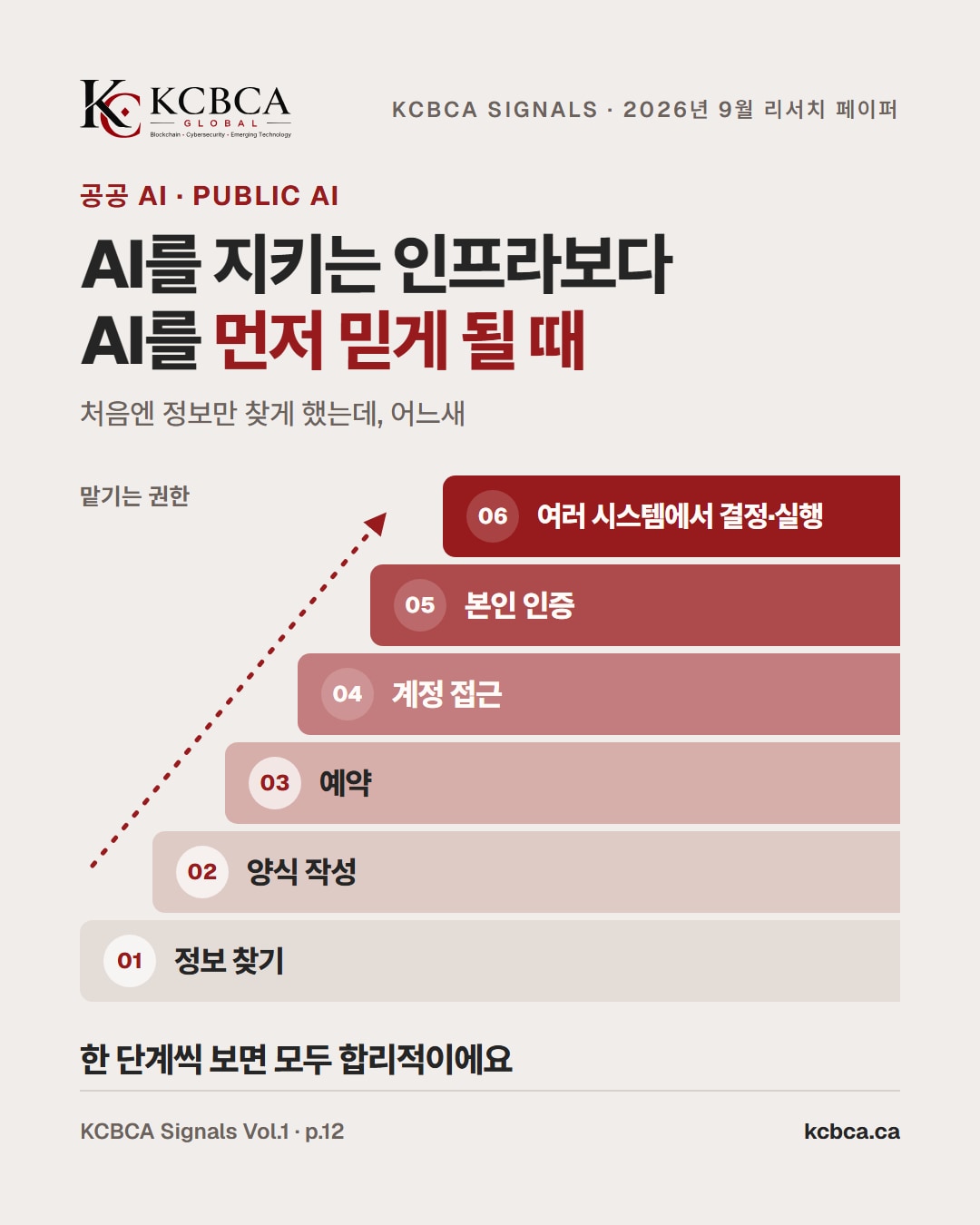
It is gradually delegating information searches, form completion, reservations, account access, identity verification, and decisions and actions across multiple systems, until trust in AI runs ahead of the infrastructure protecting it (p.12).
Each step looks reasonable on its own, making the situation easier to overlook.
The following table contains general security practices compiled by KCBCA separately from the contribution.
Use it to review AI for All security from the user's perspective.
| What to check | KCBCA general security practices |
|---|---|
| Connection permissions | Review consent screens and settings to see which accounts and information AI can access, and disconnect unused connections. |
| Sensitive information | Do not enter resident registration numbers, bank account or card numbers, passwords, or verification codes in the chat. |
| Important guidance | Verify eligibility, amounts, and deadlines on the institution's official website or in its documents. |
| Human assistance | Check in advance whether a human adviser or complaints channel is available when problems arise. |
| Unexpected notifications | Contact the relevant institution immediately about application, payment, or authentication notifications you did not request. |
Frequently asked questions
Q1. What kind of service is AI for All?
It is a government initiative in which three consortia develop general-purpose AI and public-service AI agents for nationwide use (p.10).
Check official government announcements for current information such as launch schedules.
Q2. What should users check first about AI for All security?
Check which information and systems the AI connects to.
The basics are reviewing connection permissions and entering sensitive information only to the extent necessary.
Q3. Who is responsible if AI provides incorrect guidance?
In Canada, a ruling found a company responsible for information provided by its chatbot (p.11).
How this should be handled for public-service AI remains an open question.
Q4. What is an AI sandbox?
It is a setting for testing a limited scope, including failures, before expanding nationwide.
The contributor gives one city, five public services, and 12 months as an example (p.11).
Key points
- The AI assistant is the front end; security depends on the systems behind it
- Public-service AI errors can grow with the scale of the service
- Responsibility for errors and a route to human assistance are necessary
- The contributor proposes a sandbox of one city, five services, and 12 months
The contributor says the next milestone should ask not only about “AI for everyone” but also whether we have built “AI ready for everyone” (p.12).
AI for All security begins with that question.
Read KCBCA Signals Vol.1 Issue 1 (p.10)
October series: KCBCA Signals Vol.1 Issue 1 is introduced by topic each week. The next article covers prompt injection.
References: KCBCA Signals Vol.1 Issue 1, p.10–12. Contribution by Paul Kim, founder and president of KCBCA GLOBAL