

Korea's Virtual Asset User Protection Act took effect on July 19, 2024. It requires virtual asset service providers, such as exchanges, to keep users' deposits separately with banks or other managing institutions, and prohibits unfair trading including use of material nonpublic information and market manipulation (National Law Information Center). Where and how to resolve disputes when an exchange collapses, assets are stolen in a hack, or a counterparty disappears is a separate issue.
Lawyer Youjoun Ha writes in KCBCA Signals that investors often have no effective recourse in these situations (p.22). The Act protects deposits and regulates unfair trading but has not created a dedicated procedure for virtual asset disputes (p.23). This article examines the law's protection, remaining gaps, and checks users can make before an incident.
This article draws on statutory provisions from the National Law Information Center and two lawyers' contributions to KCBCA Signals Vol.1 Issue 1 (p.22–25).
What the Act protects
The Virtual Asset User Protection Act aims to protect users' assets and regulate unfair trading (Article 1). Its main provisions are as follows.
| Provision | Contents |
|---|---|
| Article 6: Deposit protection | Deposit or entrust users' deposits to banks or other managing institutions separately from providers' own assets. Priority payment on user request when registration is cancelled, dissolution or merger is resolved, or bankruptcy is declared |
| Article 7: Virtual asset custody | Separate users' assets from providers' assets and actually hold the same types and quantities entrusted. Keep at least a specified proportion disconnected from the internet |
| Article 8: Insurance and related measures | Maintain insurance, mutual aid coverage, or reserves to meet liability for incidents such as hacking and computer failures |
| Article 10: Prohibition of unfair trading | Prohibit use of material nonpublic information, market manipulation, and fraudulent trading; restrict providers' trading in their own issued virtual assets. Violators compensate users for losses |
| Articles 11 and 12 | Prohibit blocking deposits or withdrawals without legitimate grounds; continuously monitor abnormal transactions |
The proportion kept disconnected from the internet is the ratio announced by the Financial Services Commission, at a level of 70% or higher (Enforcement Decree, Article 11). However, the Act contains no dedicated mediation or arbitration procedure for virtual asset disputes. This is the gap the contributor identifies (p.23).
Why courts also face difficulties after an incident
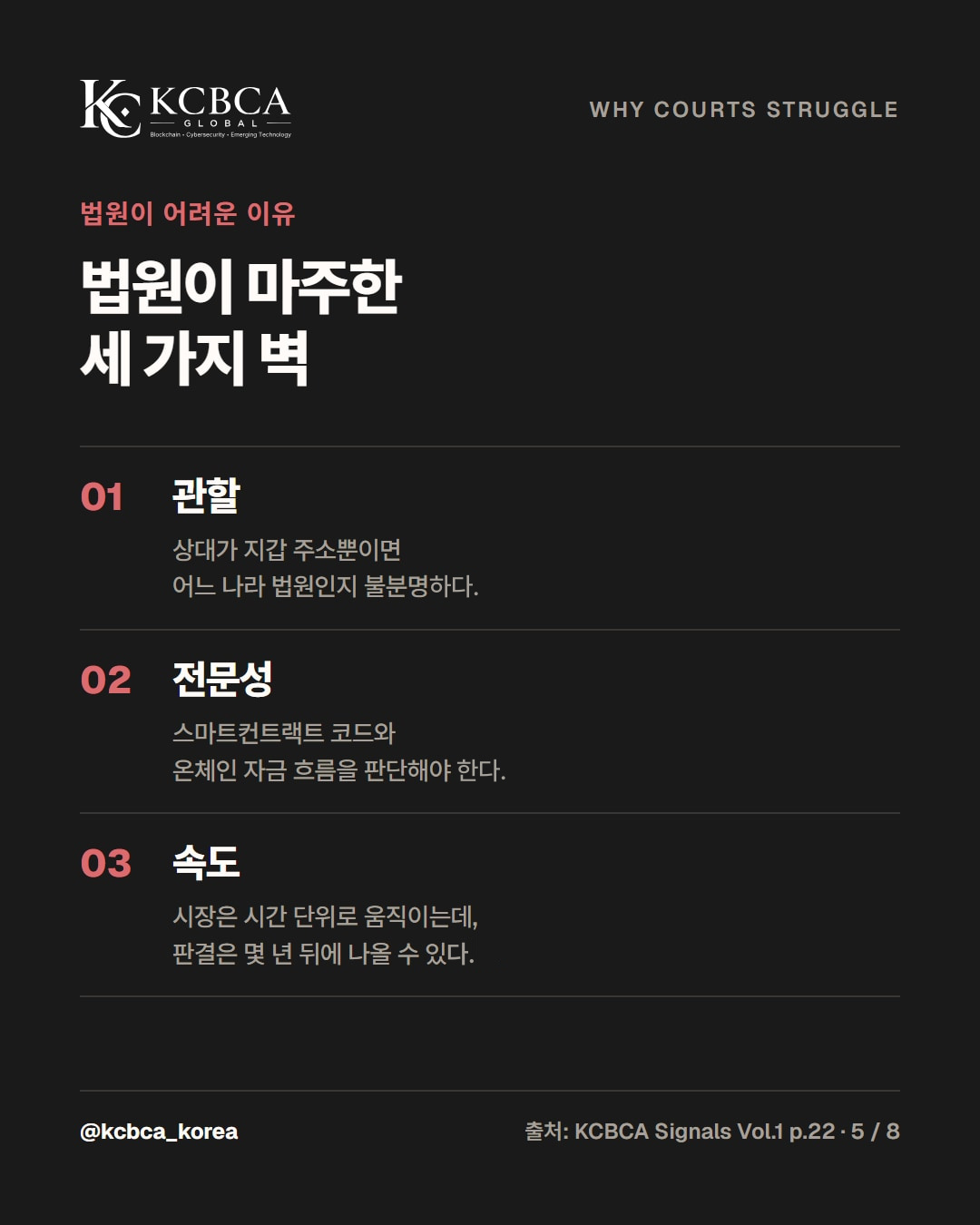
Youjoun Ha identifies three barriers for ordinary courts in virtual asset disputes (p.22).
Jurisdiction When a counterparty is known only by a wallet address, it is unclear which country's courts should hear the case.
Expertise Smart contract code and on-chain fund flows require assessment, but these are unfamiliar areas for most judges.
Speed Markets move by the hour. A judgment delivered years later may have little practical value.
How other countries approach the problem
Existing models each solve only part of the problem (p.22).
| Model | Strength | Limitation |
|---|---|---|
| UK Digital Dispute Resolution Rules and Singapore's SIAC | Fast, binding arbitration | Applies only to parties that agreed in advance |
| UAE free zones (ADGM and DIFC) | Link dispute handling to licensing | Do not mandate binding arbitration |
| On-chain dispute platforms such as Kleros | Fast and technically informed | No legal effect unless wrapped in a conventional arbitration award |
The contributor's three proposed pillars
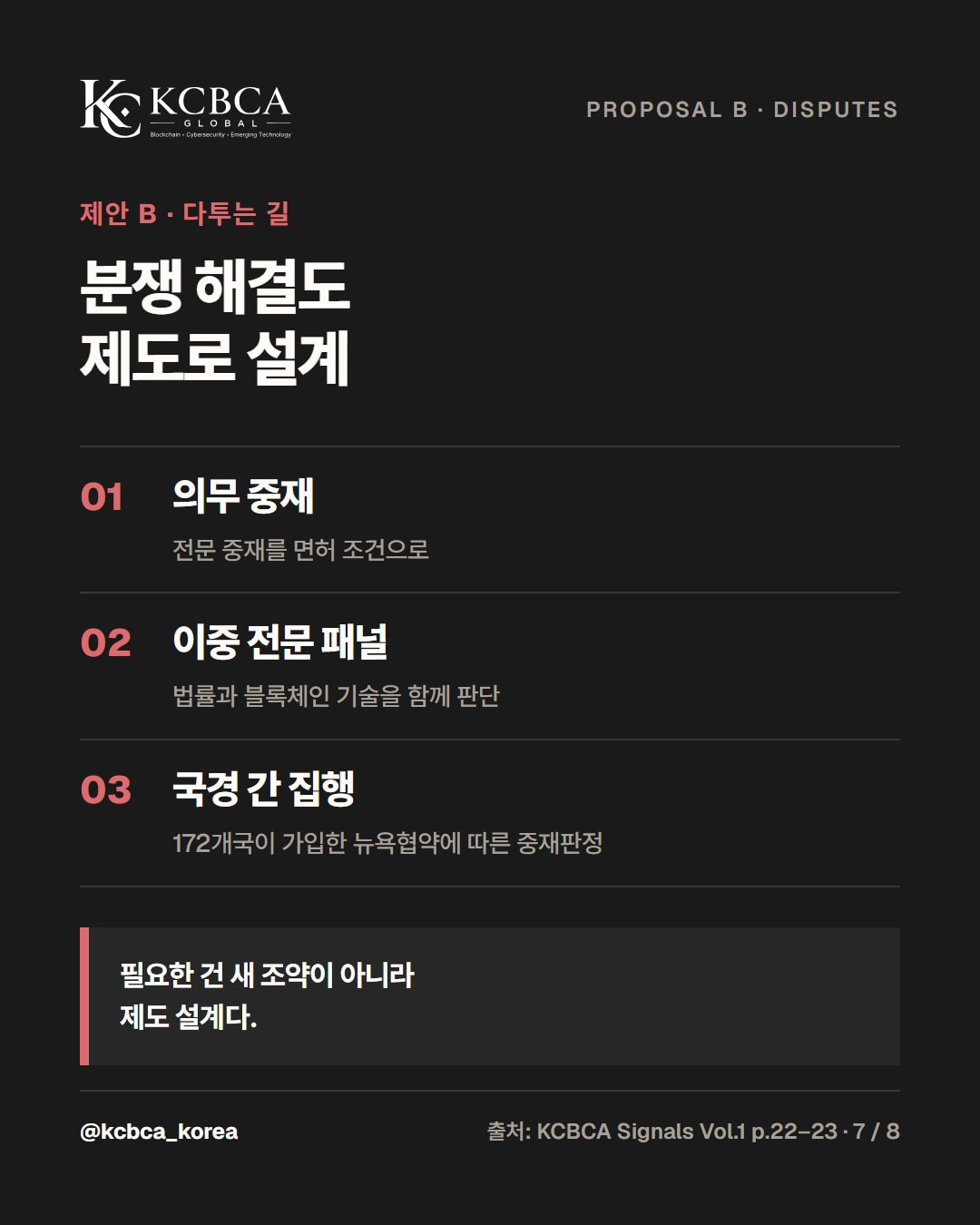
The proposal has three pillars that must work together (p.22–23).
1. Mandatory arbitration linked to licensing Make specialized, binding arbitration a condition of virtual asset licensing. The UK's Financial Ombudsman Service (FOS), Australia's AFCA, and US FINRA arbitration already link financial licensing with dispute resolution.
2. Panels with legal and technical expertise Arbitrators should combine experience in financial and technology law with an understanding of blockchain and smart contracts.
3. Cross-border enforcement Issue arbitration awards under the New York Convention, with 172 participating countries, so they can be enforced abroad.
The argument is that institutional design is needed rather than a new treaty. The contributor proposes a testbed combining Busan's blockchain regulation-free special zone and the Korean Commercial Arbitration Board (p.23).
Recovery gaps and second-stage legislation
Dispute procedures are not the only gap. Lawyer Heo Wang views the Virtual Asset User Protection Act as stage one and the Digital Asset Basic Act as stage two. At the time of writing, September 2026, no government bill had been submitted, and final passage could slip to the first half of 2027 (p.24).
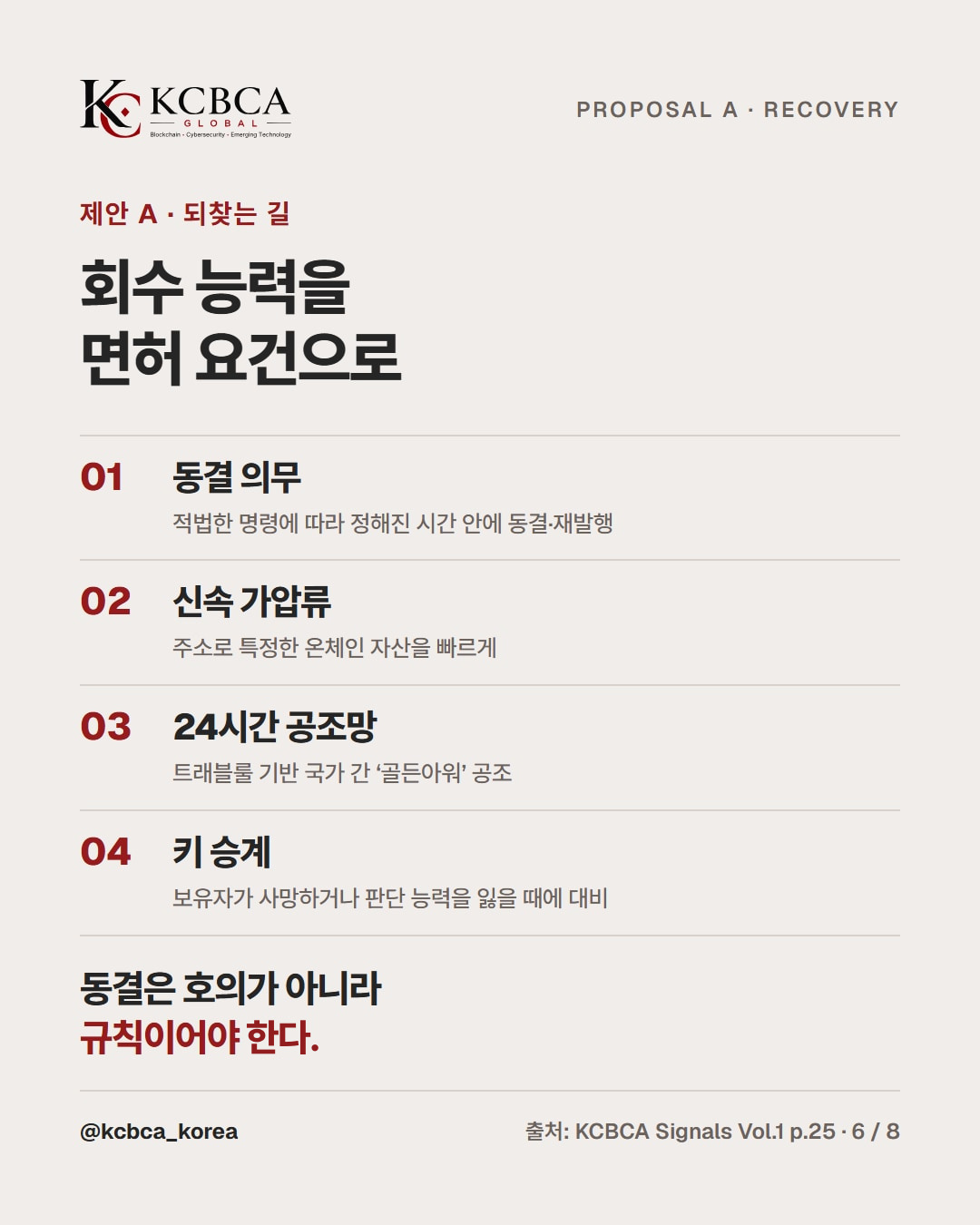
He proposes making recovery capability a licensing requirement, mandating the ability to freeze assets under lawful orders, and creating expedited provisional attachment procedures for on-chain assets identified by address (p.25). Recovery after hacking is discussed in more detail in the October 22 article on virtual asset hacking on the KCBCA blog.
What users should check now
These are matters that can be checked before an incident.
| What to check | Why |
|---|---|
| Dispute and arbitration clauses in the terms | Specify how disputes are handled (p.23) |
| Seat of arbitration and jurisdiction | Determine the country and institution where disputes are heard (p.23) |
| Deposit managing institution | Makes priority payments of deposits on user request when a provider closes (Act, Article 6) |
| Key management records | Document key management methods and succession plans for self-custodied assets (p.23, p.25) |
Frequently asked questions
Q1. What happens to deposits if an exchange closes?
Under Article 6, deposits are separated from providers' assets and held by banks or other managing institutions, with set-off and seizure prohibited. When registration is cancelled, dissolution or merger is resolved, or bankruptcy is declared, the managing institution makes priority payments on user request.
Payments are capped at the total deposits held; if insufficient, funds are allocated in proportion to each user's deposits (Enforcement Decree, Article 10). Check announcements from the managing institution and financial authorities for actual procedures.
Q2. Can this Act compensate hacking losses?
Article 8 requires providers to maintain insurance, mutual aid coverage, or reserves to meet liability for hacking, computer failures, and similar incidents. Whether compensation is paid and how much may depend on provider liability and contractual terms, so check exchange notices and official guidance from the Financial Services Commission and Financial Supervisory Service. Gaps also remain in procedures for recovering stolen assets (p.24–25).
Q3. What if a problem occurs at an overseas exchange?
The Virtual Asset User Protection Act applies to overseas conduct if its effects reach Korea (Article 3). However, jurisdiction may be unclear when the counterparty is known only by a wallet address (p.22). When losses span several countries, differing procedures and rules can leave retail investors in countries without cross-border remedies behind (p.23). Check the seat of arbitration and jurisdiction in the terms before joining.
At a glance
- The Act covers separate custody and priority payment of deposits, separate custody of virtual assets, and prohibition of unfair trading
- The Act has no dedicated mediation or arbitration procedure for virtual asset disputes
- The contributor proposes mandatory arbitration linked to licensing, legal and technical panels, and New York Convention enforcement
- Recovery and freezing remain tasks for second-stage legislation
After understanding the scope of protection under the Virtual Asset User Protection Act, check the dispute clauses, seat of arbitration, and jurisdiction in the terms of services you use.
Read KCBCA Signals Vol.1 Issue 1 (p.22–25)
View the Act at the National Law Information Center
References: National Law Information Center, Act on the Protection of Virtual Asset Users (Act No. 19563, effective July 19, 2024) and its Enforcement Decree; KCBCA Signals Vol.1 Issue 1; Youjoun Ha (Partner, Taegwang Law Firm), “Digital Assets Have a Dispute Problem,” p.22–23; Heo Wang (Lawyer, Wins Law Firm), “Security Is Not Recovery,” p.24–25. This article is neither legal advice nor investment advice.