
Smart contract hacking exploits flaws in code deployed on a blockchain to steal assets.
What deserves attention now is that a patch can also provide clues for an attack.
In Anthropic's Firefox exploit reproduction chart cited by KCBCA Signals, working proof-of-concept (PoC) code emerged within 10 minutes, and a fully working exploit within one hour.
In Anthropic's May 2026 SCONE evaluation, Mythos Preview exploited all 12 smart contract vulnerabilities that had been exploited in the real world, generating about $35 million in simulated profit (p.26).
High-impact patches should therefore undergo private AI-assisted adversarial testing before publication, checking whether they address the root cause rather than merely blocking the original attack demonstration (p.27).
This article is based on a research contribution in KCBCA Signals Vol.1 Issue 1 (p.26–27).
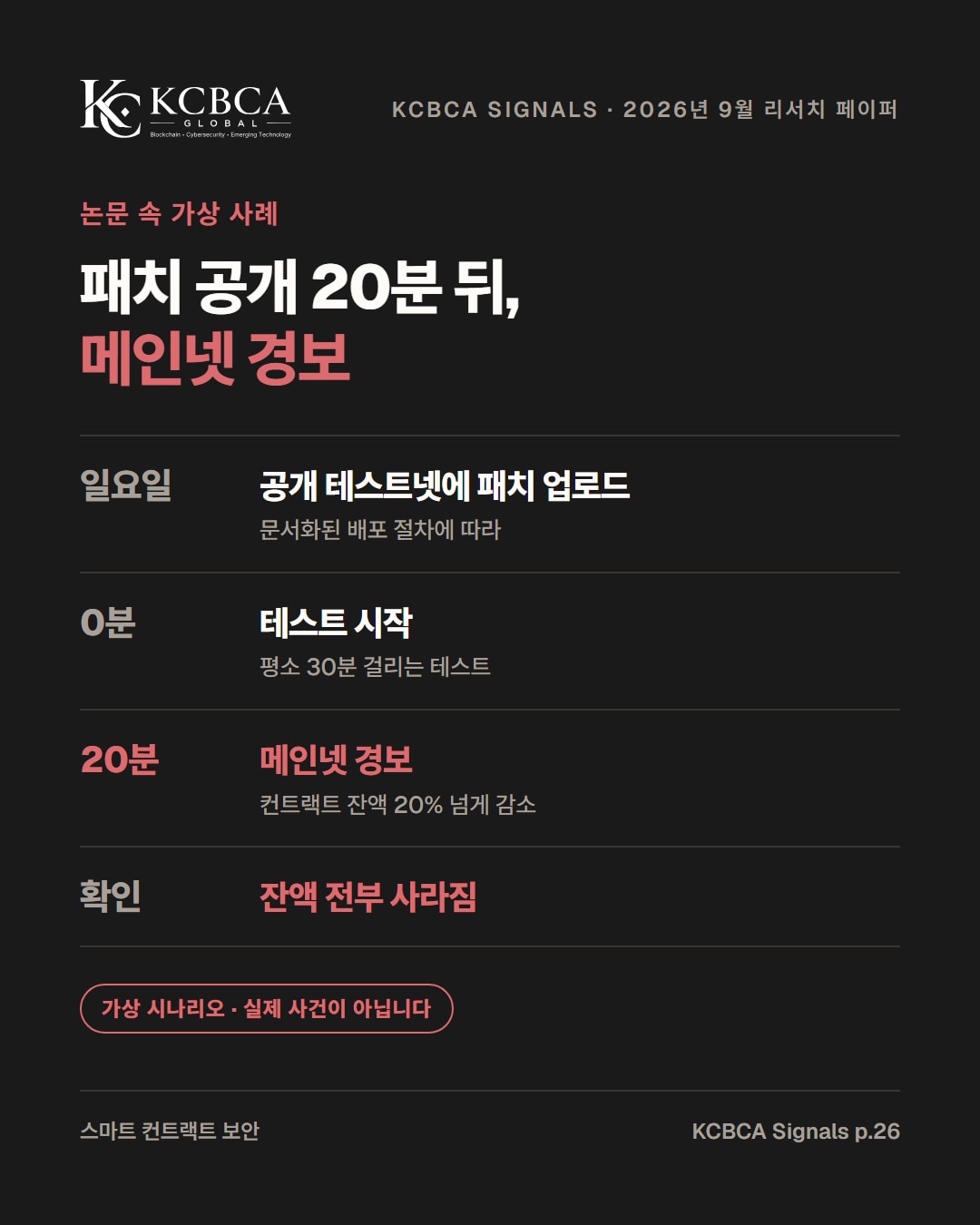
Sunday, 20 minutes after a patch is published: a hypothetical case in the paper
The paper presents this hypothetical scenario for readers to imagine.
A developer at a blockchain startup finds a vulnerability using AI.
The flaw could cost customers millions of dollars.
The team tries to fix it before attackers watching small, new projects do.
On Sunday, it publishes the patch on a public testnet according to its documented deployment procedure.
Twenty minutes into tests that normally take 30 minutes, a mainnet alert sounds.
The contract balance has dropped by more than 20%; by the time the team checks, it is all gone (p.26).
This is the smart contract hacking timeline illustrated by the paper's hypothetical case.
Reverse-engineering patches and exploiting them are established practices.
The paper notes, “This is not new. Everything has simply become faster.”
Assume attackers have agents that monitor changes and build exploits from start to finish.
Once a fix is discovered on a testnet, teams cannot expect days to respond (p.26).
The 12 SCONE vulnerabilities mentioned earlier were reported after the model's training cutoff, and the results used the best of eight attempts for each target (p.26).
Two risks: premature disclosure and incomplete fixes
The hypothetical scenario fails through “premature disclosure”: exposing a patch first on a public testnet.
Even if testing had been private and mainnet patched first, would verification, including AI penetration testing, have been sufficient?
If another path reaches the same bug, an “incomplete fix” remains a separate risk (p.26–27).
Responses to smart contract hacking must consider both disclosure timing and the scope of the fix.
The two risks are separate (adapted from Figure 3, p.26)
| Category | Kept confidential | Already public |
|---|---|---|
| Root cause addressed | Controlled candidate: verify this exact release | Public exposure: attackers can reverse-engineer it |
| Root cause not addressed | Incomplete fix: other paths may remain | Combined exposure: both risks require attention |
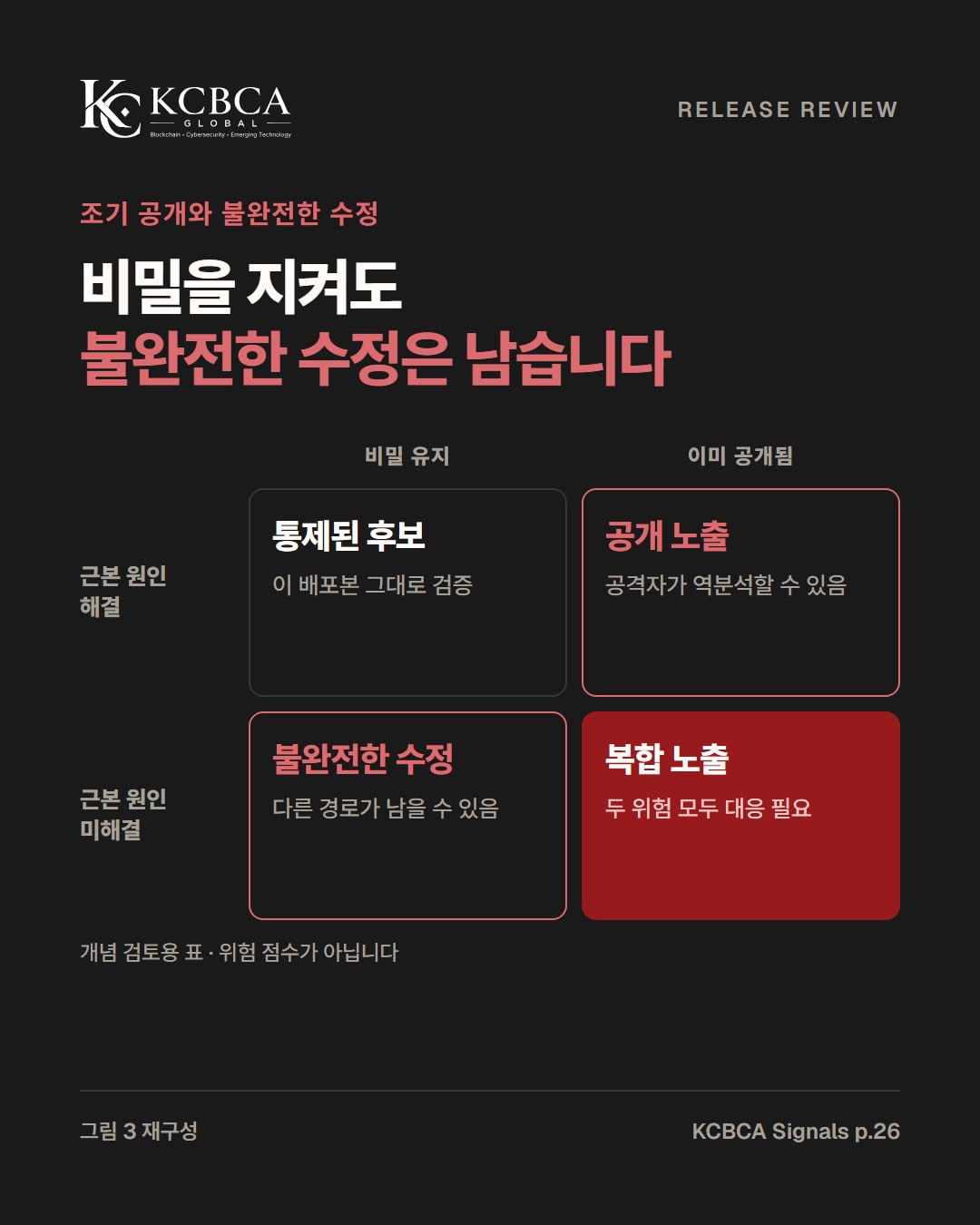
This table is for conceptual review, rather than risk scoring.
Confidentiality does not resolve an incomplete fix (p.26).
Blocking an attack demonstration may leave the root cause intact
Google Project Zero has documented cases where patches blocked only the original proof of concept, allowing attackers to reach the same vulnerability through another path (p.27).
In smart contract hacking too, failure of the original attack code is insufficient to conclude that a fix is complete.
Five questions before deployment
The paper recommends adding private AI-assisted adversarial testing to approval procedures for high-impact releases.
Examine the root cause, alternative attack paths, and weaknesses introduced by the fix, and independently verify reproducible results (p.27).
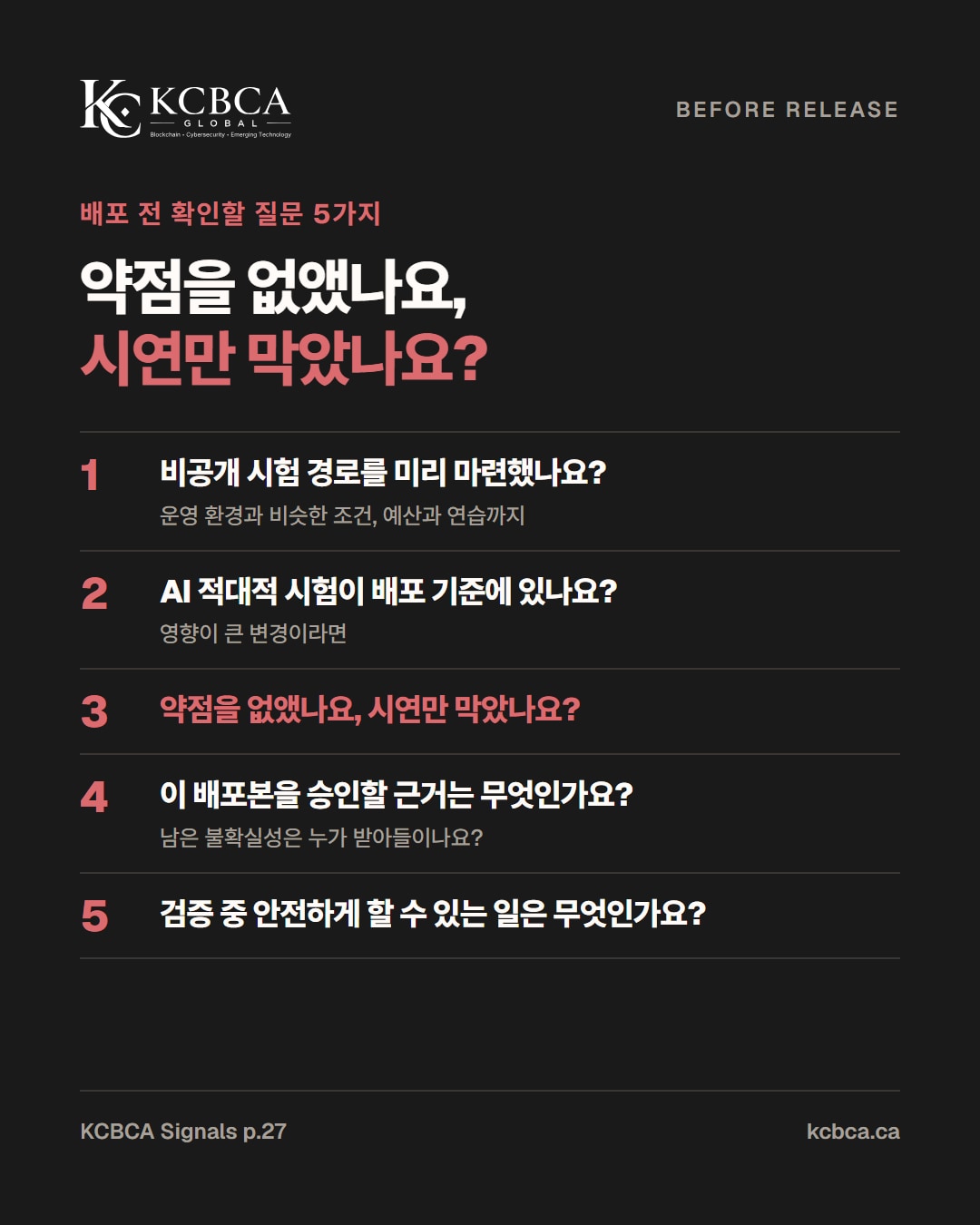
Ask the following questions when reviewing smart contract hacking risks.
| # | Question before deployment |
|---|---|
| 1 | Before an emergency, have you established a private testing route resembling production, budgeted for it, and rehearsed it? |
| 2 | Is AI adversarial testing a release requirement for high-impact changes? |
| 3 | Have you removed the weakness, or only blocked the original attack demonstration? |
| 4 | What evidence authorizes this exact release, and who accepts the remaining uncertainty? |
| 5 | What can be done safely while verification continues? |
“Before our patch becomes someone else's attack roadmap, we should attack it first with AI and demand evidence that risk has been reduced.” — KCBCA Signals Vol.1 p.27
Security-testing AI also needs controls
Using the Hugging Face incident as an example, the paper asks what would happen if the next major incident began with a project's AI security-testing agent (p.27).
Isolate the test environment, restrict external communications, and keep real signing keys out of it.
This is to prevent an agent from disclosing private fixes on an arbitrary forum (p.27).
Frequently asked questions
Q1. Is testing on a testnet safe?
A public testnet reveals the patch.
Premature disclosure was also the problem in the hypothetical case.
Assuming agents monitor changes, the fix can provide clues for an attack (p.26).
Q2. Is a security audit enough?
The paper does not separately discuss audits.
It asks whether alternative attack paths can remain even after private testing and AI penetration testing (p.26–27).
Check the evidence supporting approval of this release and who is responsible for the remaining uncertainty (p.27).
Q3. Are small projects targeted too?
The hypothetical team competes with attackers watching small, new projects (p.26).
Even small projects cannot expect ample time to respond to smart contract hacking.
Key points
- A published patch can reveal clues about a bug
- Premature disclosure and incomplete fixes are separate issues
- Check whether the root cause is resolved, rather than just the attack demonstration
- Isolate security-testing AI and keep real signing keys out of its environment
Smart contract hacking can unfold within minutes or hours.
Bring the five questions above to a team meeting before the next deployment.
The same hypothetical case will also be presented tomorrow in a 40-second video on Instagram @kcbca_korea.
Read KCBCA Signals Vol.1 Issue 1 (p.26)
References: KCBCA Signals Vol.1 Issue 1. Anton Kaiser, “When the Patch Becomes a Roadmap: Rethinking Smart-Contract Security in the AI Era,” p.26-27. Sources cited by the original: Anthropic (n-days, exploit-evals), Google Project Zero